The Olympics brought more opportunities for people to be hatin' on Johnny Weir and his style of performance. I love what he said: "Every little boy should be so lucky to turn into me."
And, you know, it's sort of true. How wonderful if we were all so lucky that we could freely be who we want to*, without judgement?
I bring this all up because I saw this video yesterday (the action starts at about 1:08).
If we could only all be so lucky as Johnny Weir and this guy, the world would be a much more fun, interesting place to be.
*= Provided of course, nobody gets hurt. Sorry, murderers, pedos, etc...

April 6, 2010
Common Lisp
I've been playing around with Common Lisp recently, using Practical Common Lisp and Let Over Lambda as guides (not gonna lie, having LOL on the spine of your book is wonderful). Last year when I went through my Scheme phase (the original URL of this blog was littleschemer.blogspot.com), I never thought I'd see the day that I'd switch sides.

FWIW, this is my iPhone background image.
I do feel like a traitor though, since even though I'm a theory-head and advocate of FP, I'm loving Common Lisp. There are a few reasons for this:
This isn't to say its all peaches and cream: I still prefer Scheme's single namespace over Common Lisp's, I prefer Scheme's naming conventions (map vs. mapcar, or worse, loop for elem in list collecting). And issues with lambdas, namely sharp-quoting and not being able to place functions in the function position (especially after learning the beauty of Scheme's semantics so well last semester) still throw me for a loop.
But after a year of mounting tension with the residents of Shelbyville, I realize they've got quite a bit right ^_^.

FWIW, this is my iPhone background image.
I do feel like a traitor though, since even though I'm a theory-head and advocate of FP, I'm loving Common Lisp. There are a few reasons for this:
- Simpler macros. I'll bet some hardcore Schemers will disagree with me on this, but I feel that defmacro is much, much simpler to learn than syntax-case, and syntax-rules always leaves me wanting more. Maybe I'm deficient, but I took to defmacro immediately, whereas when I want to do anything non-trivial in Scheme, I feel myself always going back to Dybvig's explanations, taking far longer than I'd like.
While in principle I'm for hygiene as the default, it's not too big an issue in practice. Hoyte gives a great little macro (one of the first in his book) that ensures you fresh variables whenever you want them, without even having to declare them! - Language libraries. CL comes with every function you could ever want. It comes back to what Peter Norvig said in Paradigms in Artificial Intelligence Programming (paraphrasing): Scheme is one of the smallest languages to define (< 50 pages), whereas CL is one of the largest (> 1200 pages).
While some Schemes provide these, since they aren't part of the standard you aren't guaranteed anything across implementations. In fact, my favorite Scheme in terms of libraries (good ole' PLT) even broke across versions when they enforced module declarations at the top of every file.
Besides, once a Scheme gets these, they stop wanting to be called Scheme.
This isn't to say its all peaches and cream: I still prefer Scheme's single namespace over Common Lisp's, I prefer Scheme's naming conventions (map vs. mapcar, or worse, loop for elem in list collecting). And issues with lambdas, namely sharp-quoting and not being able to place functions in the function position (especially after learning the beauty of Scheme's semantics so well last semester) still throw me for a loop.
But after a year of mounting tension with the residents of Shelbyville, I realize they've got quite a bit right ^_^.
March 31, 2010
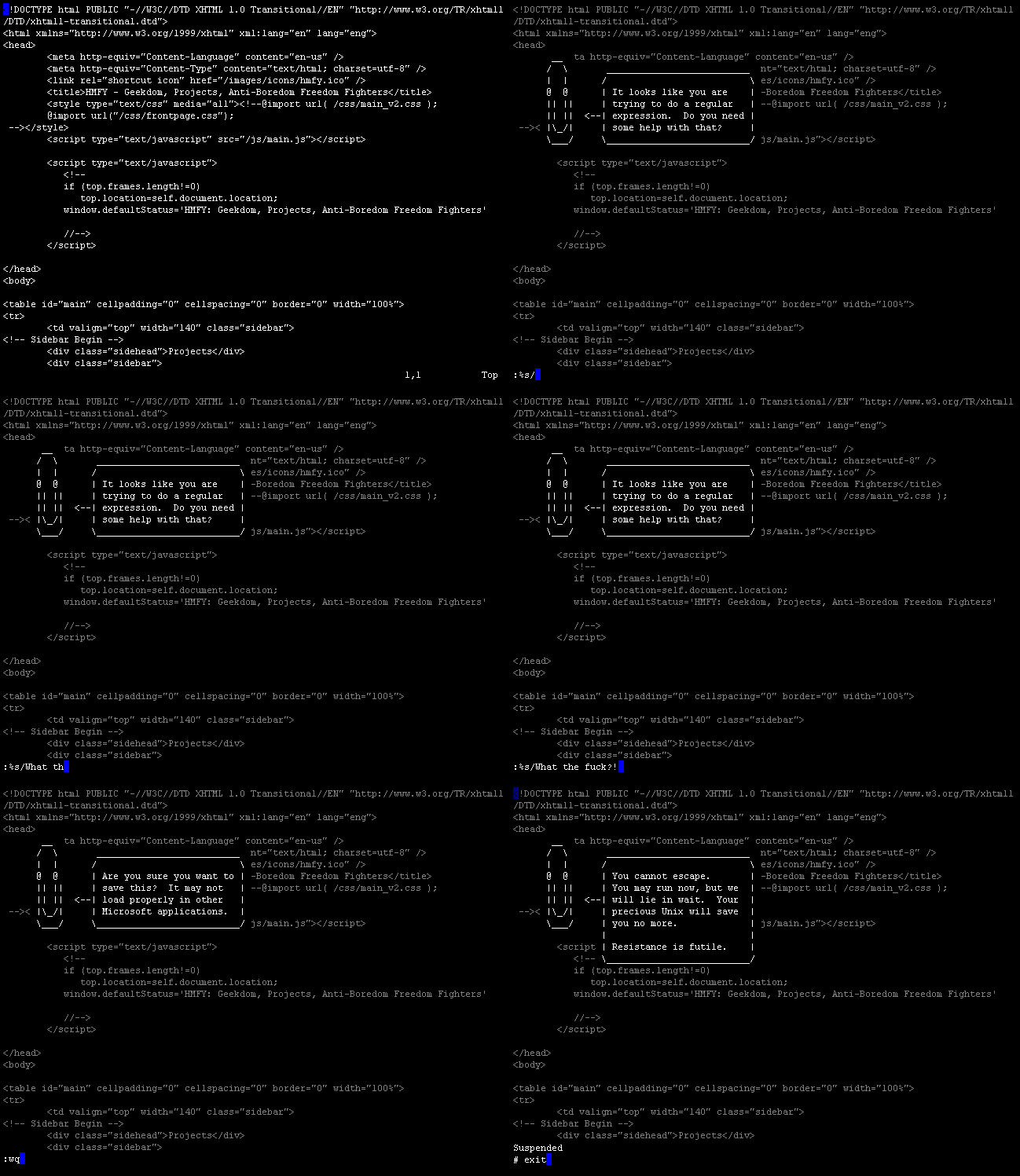
Code-related lulz
The first is the only conceivable improvement I could think of for my baby, vim. The second is the source code for ed.
Both from this reddit thread.
Both from this reddit thread.
Paul the lil' misogynist
The longer I'm away from home, the more I forget about where I come from. I'm on Spring Break now, and usually when I'm home I spend some time digging around the house for archiving material. During my last Spring Break I put some kiddie pictures on Facebook that was met with much enthusiasm from my family. This time, I have a video.
My school had a tradition of putting 4th graders in little skits, and I was in one called Sammy Carducci's Guide to Women. (based, as I just found out, on a terrible-looking novel for middle schoolers).
The director of these shows recorded them, and gave to me a DVD he'd made as a graduation gift.
The second half of the scene is below (the first half is out of focus, you need to wait a few seconds on what I've embedded below). Lord, what a strange thing to look back on.
Highlights are at 2:13 (I make some really amazing, kind of demonic throat sound), and the freak out at 3:10.
Transcript of the scene after the jump...
----
Unrelated, but cool links I found this morning: a concise prediction I agree with on where computers are headed (differentiating between 'people' computers and 'geek' computers).
Bullet points on why smart people fail to be successful. While the choice of words is muddy, I found a lot of his points resonated with me. Arguably the best thing I learned at Brown was the hard experience of occasionally failing, which was absolutely necessary to (stealing his jargon) 'leave the sandbox.'
Finally, having front-end web dev skills went from being able to navigate awful w3schools tutorials into a proper science of its own. Even if you know CSS and basic Javascript, there's pitfall after pitfall in the trenches of the real world. I found this list of requirements for new hires to be a good primer on what are contemporary considerations.
March 23, 2010
Books, Books, the Musical Fruit
A lot of big-time, 'real' bloggers are writing about their 10 most influential books. I'll present mine here, stealing some terminology: this is my 'gut list,' not my 'I've thought about this for a long time' list:
Don Quijote (Cervantes)

'Misfit' entertainment is on the rise: Napoleon Dynamite, Eagle vs. Shark, and pretty much everything starring Michael Cera are examples of movies where we celebrate and flesh out the weirdos, oddballs, and losers of society into something a little higher. This 'not-like-the-others' quality is all over my list.
None of them hold a candle to Don Quijote, however. He embodies that cute Akira Kurosawa line: "In a mad world, only the mad are sane." While you the reader know he's off his rocker, and that you're "better off," you sort of envy him. He's happy as a clam! He's living the adventure! You can almost always open up to a random point in either of the two volumes to see Quijote having a good time, and Sancho being completely lovable.
I feel like my connection with this book is like a lot of religious people's with their Holy Text: I haven't read every word of it, and its been so long since I read it that I'm probably just taking what I want to remember out of it. I'm sure my many memories are easily amended and disproven by someone who's really studied it. But it left enough of a mark on me to bring my dog-eared, notes-in-the-margin copy everywhere I go.
Short Stories (Jorge Luis Borges)

My former Spanish teacher quipped that Borges probably wasn't the most read Spanish author, but the most reread. You can see why: his short fiction is jam-packed with beautiful imagery, contradiction, love and meaning. They're Everlasting Gobstoppers.
The White Tiger (Aravind Adiga)

A recent addition, I just finished this about a month ago and absolutely loved it. Murder is one of the most interesting themes in fiction, especially how we can make someone else killable. The character's progression/descent into murder in a modern capitalist society is entertaining and evocative.
March 22, 2010
Games
Made two demo videos, for my Independent Study making games. The first was our collaborative effort, a Hungry Hungry Hippos-type game called Penguins:
The second was a Tetris Attack knockoff I call FlipTile, which I did on my own just for kicks one weekend. I hope to take it far, but time! TIME!!!
I rather enjoy Android dev, and game dev in particular. Maybe I can pursue this?
After working on these videos, I'm tired of hearing my own voice. I need to make another one of these tonight, chances are I'll use an accent.
Finally, I might dedicate a future post to the Fail that is iMovie. Apple recovered the computer market in the early 2000's with OS X, and one of the major plugs was the package that was later packaged as iLife. iMovie used to be a major perk of migrating, but since they branched the two to iMovie (free) and iMovie HD (which they now sell!), the free one is full of bugs and anti-features.
March 21, 2010
On Jazz, popularity
Another not-very-hackery article on Hacker News caught my attention. Dyske Suematsu (in 2003) gives a few reasons to why we don't hear jazz on Top-40 radio stations, making claims like "our ears are getting lazier."
I'm taking a computer science class called Solving Hard Problems, but reading the article and the epic comment thread that ensued reminds me that our Hard Problems are really bollocks: our problems are at least solvable. Even if they aren't, they're well defined enough to know when we've solved them.
Try answering "Why isn't Jazz popular?" and all you can do is approximate. Social scientists have much more courage than I do.
To paraphrase Valentine Coverly from Arcadia, "We know better what's happening between two electrons or in the inside of a star than whether or not it'll rain on our picnic next Sunday." Valentine spoke of knowing about the really big and really small, but that chaos theory prevents us from knowing anything in between (things that, you know, matter).
(to break visual tedium, enjoy the pictures from my high school production of Arcadia, which I directed as a senior for our annual student-directed show. Do they still do them?)
I told you that to tell you this: I'll give some reasons why I believe we don't hear more jazz all around us, but I understand the limitations of my arguments, and that they're specific to me.

Chloe, Valentine, Hannah, Bernard, and Gus
I'm taking a computer science class called Solving Hard Problems, but reading the article and the epic comment thread that ensued reminds me that our Hard Problems are really bollocks: our problems are at least solvable. Even if they aren't, they're well defined enough to know when we've solved them.
Try answering "Why isn't Jazz popular?" and all you can do is approximate. Social scientists have much more courage than I do.
To paraphrase Valentine Coverly from Arcadia, "We know better what's happening between two electrons or in the inside of a star than whether or not it'll rain on our picnic next Sunday." Valentine spoke of knowing about the really big and really small, but that chaos theory prevents us from knowing anything in between (things that, you know, matter).
(to break visual tedium, enjoy the pictures from my high school production of Arcadia, which I directed as a senior for our annual student-directed show. Do they still do them?)
I told you that to tell you this: I'll give some reasons why I believe we don't hear more jazz all around us, but I understand the limitations of my arguments, and that they're specific to me.
Chloe, Valentine, Hannah, Bernard, and Gus
Subscribe to:
Posts (Atom)


 Posts